How to join the network
through mining
Renting
Hardware
To mine the GNK token, you don't need to buy expensive equipment. Rent ready-to-use GPU power from trusted providers and launch a node right away. Earn PoC weight and GNK for computing without capital expenditures on hardware.
Connecting your
own hardware
Do you have powerful GPUs or know where to rent them? Connect them to the Gonka network and keep 100% of your PoC weight without pool fees. Your existing infrastructure becomes a source of GNK tokens and part of the global AI layer.
Entering mining
through a pool
The easiest way to start. Buy a share of computing power in a pool and receive GNK proportionally to your contribution. Operators handle the technical side. You simply provide capital and collect rewards.
 Remember: an early network = a larger share of the emission
GNK mining means providing compute power (GPU) to the Gonka network.
These resources are used for real AI workloads. The network rewards miners with GNK tokens based on the amount of GPU resources they provide.
In simple terms:
Gonka's infrastructure is built on miners' GPU
power — and they receive GNK in return for that contribution.
Who Gonka Token
Miners Are
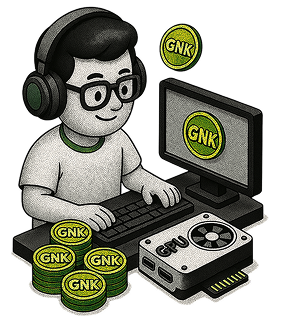
Miners in the Gonka network run compute nodes and turn AI infrastructure into income, receiving GNK tokens proportionally to their PoC weight — the amount of verified compute and the quality of participation in the network
A miner connects hardware or rents a ready-made node and takes part in task processing and PoC sprints. Rewards are начисляются for the completed and verified volume of work.
Each GNK miner earns crypto while simultaneously supporting the decentralized infrastructure of AI models backed by the network. This role gives miners a direct economic and personal incentive to ensure reliability and availability of capacity.
What Miners Receive
GNK is the base token of the protocol and is used to pay for compute.
Miners in the Gonka network receive GNK tokens for verified compute work, including language-model inference and participation in the Proof-of-Compute mechanism.
The reward size depends on node power, reliability, and contribution to overall network performance per epoch.
Miner profitability depends on the amount of verified work performed and the market price of GNK.
How GNK Rewards
Are Distributed
Rewards are distributed per epoch based on verified compute contribution.
The total reward per epoch (323,000 GNK at launch) is
formed as a fixed pool
and distributed proportionally to the PoC
weight of all participants.
How Rewards Are
Distributed

The protocol issues GNK according to a predefined schedule similar to Bitcoin's emission model.
Payments for completed requests come directly from developers and clients. Funds are reserved in escrow and distributed to the nodes that successfully execute the tasks.
The Gonka network rewards miners who provide GPU capacity and process inference requests.
Each epoch has a fixed GNK reward pool, distributed among miners proportionally to their verified compute contribution (Proof-of-Compute).
Each completed request increases the miner's PoC weight and influences GNK rewards.
Since the reward pool is fixed, an increase in the number of miners reduces the reward share per GPU. At earlier stages of the network, the reward share per unit of compute is therefore higher.
How GNK Can Be Used
GNK in the Gonka ecosystem is a utility token. It is needed to pay for inference, obtain liquidity, and participate in long-term network incentives

Selling
GNK tokens do not yet have an official listing. However, they can be sold or exchanged via various OTC venues and through like-minded members of the Gonka ecosystem community.
This enables participants focused on short-term returns to use a "mine → sell" model without deep involvement in the long-term network economy.

Holding
Holding GNK is a strategy for participants who expect growing demand for decentralized inference and training in the Gonka network.
A host can hold GNK while waiting for the ecosystem to expand: new applications, integrations with external protocols, and growth in total inference request volume.
Holders may gain advantages in access to services, staking, and, in the future, governance features.

Paying for Inference
A GNK miner can use the mined token as "fuel" for their own AI queries in the Gonka network.
If you need to test an AI model, build a demo, launch your own bot or service — you simply pay those requests in GNK instead of stablecoins or another cryptocurrency.
The process looks like this:
- Top up your inference balance with GNK.
- Send requests via an OpenAI-compatible API.
- The network reserves tokens in escrow and, as tasks are completed, distributes them to hosts that compute your requests.
This way, the miner turns part of the mined GNK not into immediate cash via selling, but into access to real compute power. You "pay yourself and other hosts" for a useful AI service.
How GNK Mining Differs From Bitcoin, Ethereum and Bittensor Mining

Gonka
GNK uses Proof-of-Compute (PoC). GPUs perform real AI tasks (LLM inference and validation), creating value for AI application developers while earning epoch rewards.
Gonka GNK focuses on inference for large language models. Currently this is Qwen3. More LLMs will be added later.
A single GNK network uses transformer-based PoC with transparent weight calculation by formula: compute volume + uptime + validation quality = share of the fixed GNK pool per epoch (323K at launch).
The key difference between TAO and GNK mining is that Bittensor is a marketplace of ML services with competing subnets, while Gonka is infrastructure for LLM inference with an emphasis on stability and scalability.

Ethereum
Ethereum moved to Proof-of-Stake. Instead of GPU mining, validators stake ETH to produce blocks and provide security.

Bitcoin
Bitcoin uses classic Proof-of-Work. ASIC miners solve cryptographic hash puzzles to secure the blockchain and issue BTC. Such computations do not create additional value outside the network.

Bittensor
Bittensor (TAO) is a decentralized marketplace for ML models with many subnets. Validators assess the quality of miners' ML outputs using a complex matrix of metrics, creating competition across different model types and tasks.
How Miners Influence
The Gonka Network

Miners in Gonka do more than provide compute power — they participate in governing how the network evolves.
Your voting power is based on your verified contribution to the network.
It depends on:
- the amount of GPU capacity you provide,
- the volume of completed and validated work,
- and your node's reliability and uptime.
The more compute you contribute and the more work you complete, the stronger your influence in governance.
There is no centralized authority — decisions are made collectively by active contributors.
Vote on Protocol
Updates
Approve changes to how the network operates.
Submit Governance Proposals and Vote on Them

Propose improvements and participate in their approval.
Vote on Emission and Key Network Parameters

Influence reward structure and core system rules.
Participation in GNK mining does not guarantee financial outcomes. Rewards depend solely on verified compute contribution and network conditions.
Mine itWhy Participate...
Lower network participation at early stages.
At earlier phases of network growth, fewer nodes share the fixed
GNK reward pool per epoch.
As more GPU capacity joins, the
same emission is distributed across a larger number of
participants.
Structural growth in AI compute demand.
AI adoption continues to expand globally. The increasing use of large language models and AI applications drives sustained demand for compute infrastructure. Gonka operates within this broader compute market.
Network scaling phase
As the network grows, infrastructure matures and participation
increases.
Early participants operate within the initial
distribution phase of the protocol.
Frequently Asked
Questions
You can deploy your own node or use infrastructure from partner hosts. This choice allows you to pick a convenient level of involvement and technical responsibility.
Setup difficulty depends on your chosen method. Partner hosts handle the technical side for you.
The Proof-of-Compute mechanism verifies compute contributions through cryptographic validation.
GNK tokens can be exchanged via OTC venues and through ecosystem community members.
Rewards depend on verified compute contribution and network conditions. Financial outcomes are not guaranteed.
Yes, you can add more GPU capacity or nodes to increase your PoC weight and rewards.
The fixed reward pool means more participants reduce individual shares, but growing demand offsets this over time.
Income depends on your node's uptime, reliability, and the overall network participation rate.
All weight calculations and reward distributions are transparent and verifiable on-chain.
Early participation means fewer nodes share the fixed reward pool, resulting in a higher share per participant.
You can join through a mining pool, rent compute from partner hosts, or participate as a developer using the Gonka API.